Seller interviews
The listing started before anyone opened OLX
I began with the work sellers were already doing. They compared similar cars to set a price, cleaned the vehicle and waited for a good opportunity to take photos. In two rounds of interviews, nine days apart, I asked sellers to walk me through what happened before, during and after they filled in the form.
I mapped those steps alongside the posting journey. It changed how I read an unfinished listing. A seller might still be looking up a specification or planning to take better photos. Leaving the form could be part of selling the car.

Form analysis
Where were sellers getting stuck?
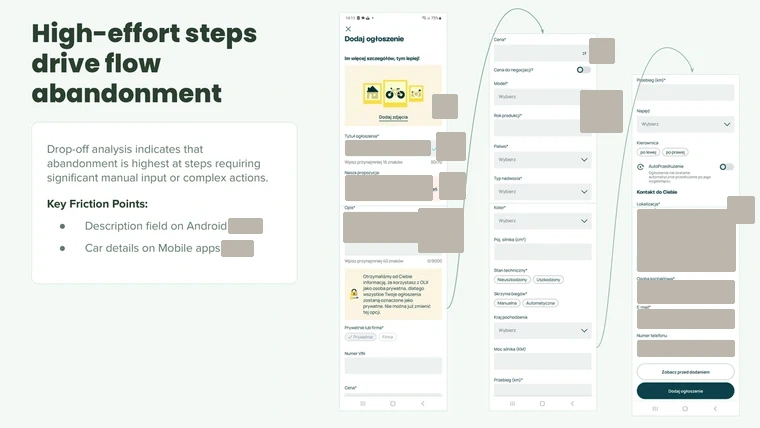
I compared the interview findings with a survey of people who had abandoned a listing and the data from the posting form. Vehicle specifications took time to enter on mobile. On Android, the description was a point where sellers often stopped.
I audited the form and compared it with other automotive marketplaces. One seller remembered entering a vehicle identification number (VIN) on OTOMOTO and seeing the model and year appear. On OLX, they remembered selecting equipment manually. That gave me a question for the redesign. Which details could the form fill in for the seller?
Consumers Segment Days
We tried an idea while the conversations were fresh
At Consumers Segment Days, I joined colleagues working on automotive marketplaces. We spoke with sellers in small groups. One detail helped explain why the written description mattered. Sellers used it to mention recent maintenance or explain why they were selling. Those details could help a buyer decide whether to trust the listing.
By the second day, our group had a workshop prototype in Lovable. I brought the seller observations and workshop ideas back to the OLX team.
Engineering workshop
We separated a difficult field from a genuine pause
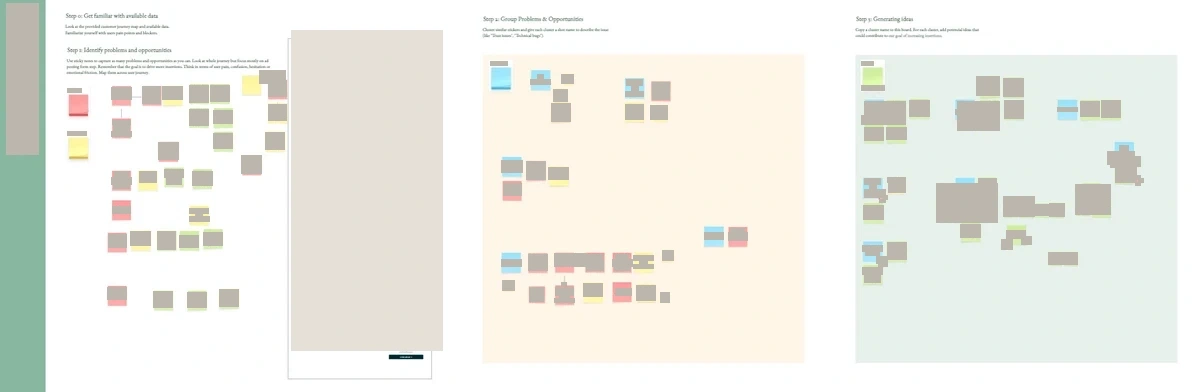
In a separate workshop with the OLX engineers, we mapped issues onto the seller journey, grouped related observations, then generated and prioritised ideas.
We kept the option to save a draft and return to it as a separate idea for interrupted sessions. For the two concepts I took into design, I focused on looking up vehicle details and helping someone start a description.
Concept design · VIN
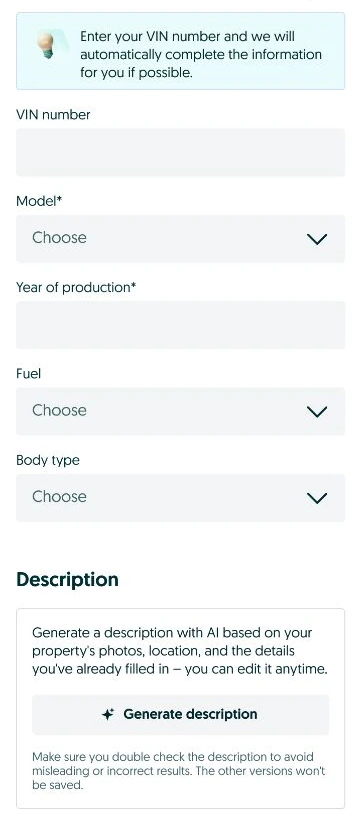
Use the VIN to fill in vehicle details
I designed a VIN lookup within the vehicle-details step. A seller could enter one identifier and use the available specifications to populate the form. The model and year from the interview were concrete examples of details a seller had already seen another service retrieve.
I wanted to find out whether fewer manual selections would help more sellers finish posting. I took that hypothesis, along with the mobile concept, to design review.
Concept design · AI
Give the seller a first draft
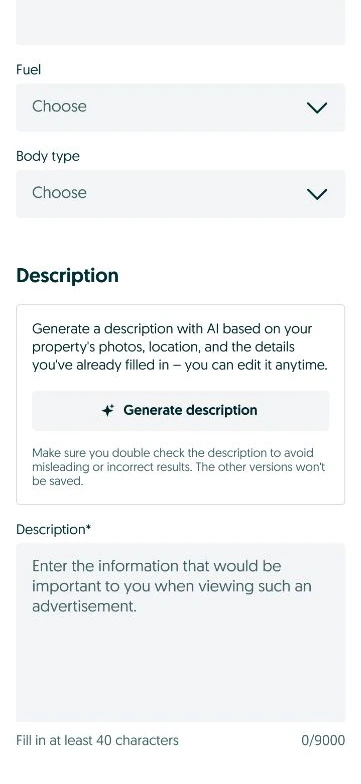
The description asked for a different kind of effort. Some of what a seller wanted to write was already in the form, but the reason for selling or a recent repair was something only the owner could explain.
I placed an optional AI writing action beside the description field. It would give the seller an editable first draft, with room to add the history that mattered to a buyer. The question for testing was whether that starting point would make it easier to finish a listing on a phone.
Design review · next steps
Define what would count as an easier listing
I presented both concepts while they were still in design. I proposed testing them with sellers, refining them with that feedback and preparing variants for an A/B test.
In the measurement plan, the main question was whether more sellers who started a listing went on to publish it. Time spent in the form and exits at individual steps would help explain the result. Daily new listings would show how any change played out across the marketplace.